

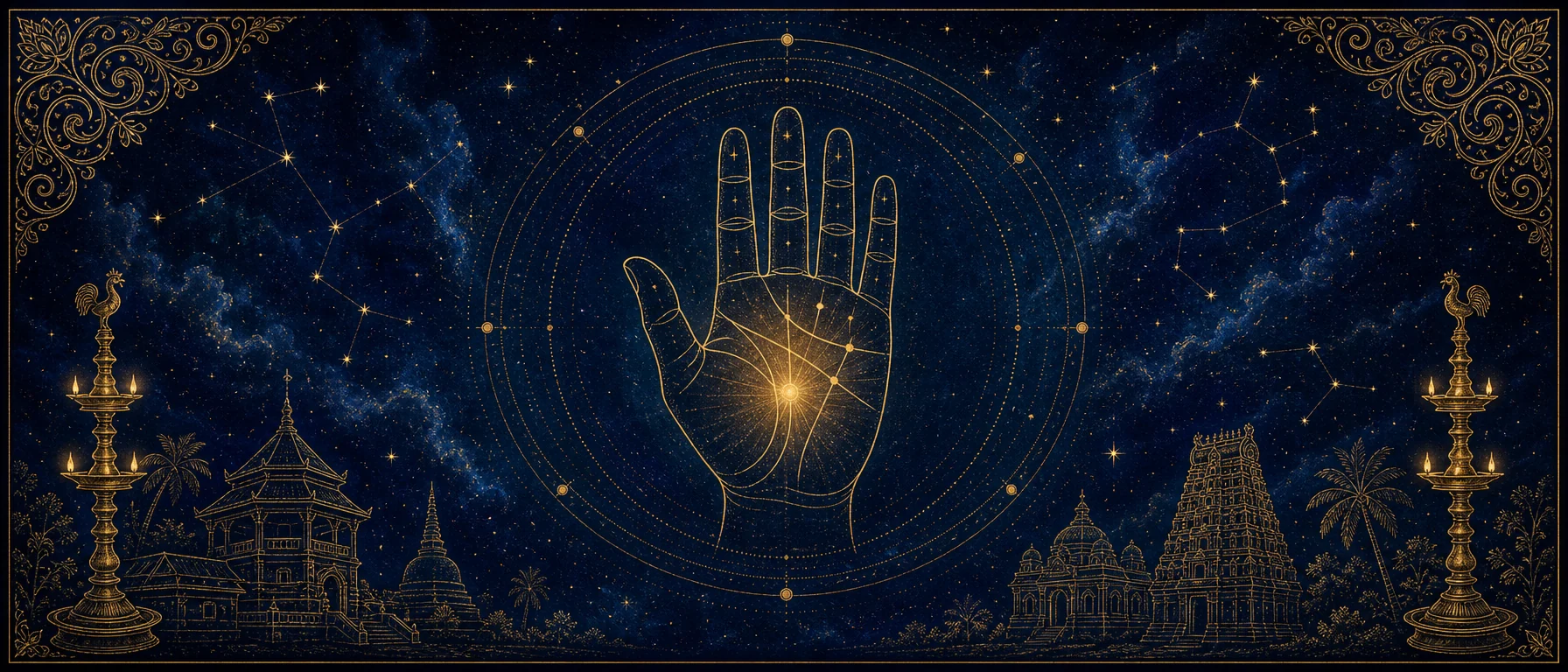
What palm reading is, said plainly
Palmistry is a tradition. It has been read in Sri Lanka and across South Asia for a very long time, and it has no evidential basis for anything it claims about a person.
What is true is narrower and more interesting. The creases on a hand are real, they differ from person to person, and they can be located and measured. Grahachara measures them first, shows you the figures, and only then tells you what the tradition reads into them. The line between those two things is drawn on the screen, in front of you, every time.
How Grahachara reads a palm
A photograph goes in. Before a single word is written, the hand is measured.
- Twenty one hand landmarks, located on your photograph: fingertips, every joint, the base of the thumb, the wrist.
- The creases traced by computer vision working from those landmarks, rather than guessed at from a description of the picture.
- Palm width divided by height. At 0.85 or above, the palm counts as square.
- Middle finger divided by palm height. At 0.90 or above, the fingers count as long.
- Thumb opening, measured from the wrist, between the thumb tip and the index knuckle.
- Index divided by ring finger. A shape fact only. No claim is attached to it.
Those first two ratios decide the hand shape: an Earth hand, an Air hand, a Fire hand or a Water hand. Every reading shows you the numbers in a panel called What we measured, each one beside the threshold it was judged against, so you can check them against your own hand.
The reading comes after that, written from the measurements, and each part of it will tell you which mark on your hand it came from.
Every line and mount, in plain terms
The explorer above is this list. Each entry says what gets measured on your photograph first, then, separately, what the tradition reads into it. Every one has its own link, so you can point somebody straight at it.
Heart line
What gets measured
Where it begins on the percussion edge, how far across the palm it runs, and how much it curves as it climbs toward the fingers.
What the tradition makes of it
Read for how you attach to people and how openly that shows. A high curve is taken as feeling worn on the outside, a flatter run as feeling kept in reserve.
Worth knowing
It is the topmost of the three long creases, the one nearest the fingers. On most hands it is the easiest of the four to find in a photograph.
Head line
What gets measured
Where it starts relative to the life line, its slope across the palm, and where it ends.
What the tradition makes of it
Read for how you work a problem. A level run is taken as practical and stepwise, a dipping one as circling a question before answering it.
Worth knowing
It runs below the heart line and often shares a starting point with the life line. Where the two begin joined, the tradition reads caution before acting; where they begin apart, it reads the opposite.
Life line
What gets measured
The width of its arc around the ball of the thumb, and its depth sampled at points along its length.
What the tradition makes of it
Read for energy, appetite and pace: how you spend yourself and how you get it back. It is not a gauge of lifespan, and length has nothing to do with how long anyone lives.
Worth knowing
This is the most misread line on the hand. A short life line does not mean a short life, and the app will not say that it does: Cheiro, who wrote the standard text on the subject, stated plainly that the line's length has no bearing on how long anyone lives.
Fate line
What gets measured
Whether it is present at all, where on the palm it starts, and how straight it holds as it rises. Height up the palm, not distance along the line, is what any timing is read from.
What the tradition makes of it
Read for how directed working life feels. Many hands carry no fate line, which the tradition takes as a path made rather than followed.
Worth knowing
Having no fate line is common and is not a defect. When a photograph does not show one, the reading says it is not visible rather than inventing it.
Mount of Mercury
What gets measured
The fullness under the little finger, relative to its neighbours.
What the tradition makes of it
Read for quickness with words, trade and persuasion.
Worth knowing
It sits at the percussion edge, which is also where the heart line begins, so the two are read together as often as apart.
Mount of Apollo
What gets measured
The fullness under the ring finger, relative to its neighbours.
What the tradition makes of it
Read for the pull toward making things and toward being appreciated for them.
Worth knowing
Also called the mount of the Sun, and in Sinhala the ravi mount, after the same planet.
Mount of Saturn
What gets measured
The fullness under the middle finger, relative to its neighbours.
What the tradition makes of it
Read for seriousness, patience, and a liking for work that takes a long time.
Worth knowing
It is usually the flattest of the four finger mounts, so a Saturn that stands out at all is read as saying something.
Mount of Jupiter
What gets measured
The fullness under the index finger, measured against the other mounts on the same hand rather than against anyone else's.
What the tradition makes of it
Read for appetite to lead and to be seen doing it.
Worth knowing
Mounts are always relative. A hand that is full everywhere has no high Jupiter, and comparing your mounts to somebody else's photograph tells you nothing.
Mount of Venus
What gets measured
The ball of the thumb, enclosed by the life line: its breadth and how far it stands out.
What the tradition makes of it
Read for warmth, sociability and physical appetite for life.
Worth knowing
It is the largest mount on almost every hand, and the life line's arc around it is what the app measures rather than the mount alone.
Mount of Luna
What gets measured
The pad at the outer base of the palm, opposite the thumb.
What the tradition makes of it
Read for imagination, and for restlessness that shows up as wanting to be somewhere else.
Worth knowing
Also called the mount of the Moon. It sits diagonally opposite Venus, and the tradition reads the pair against each other.
Hand shape
What gets measured
Palm width divided by height, and middle finger divided by palm height. At 0.85 the palm counts as square; at 0.90 the fingers count as long.
What the tradition makes of it
Those two ratios name the hand: Earth, Air, Fire or Water. It is the one part of the reading you can check with a ruler.
Worth knowing
This is the only part of a palm reading with a stated threshold you can verify yourself. Measure your own hand and you will get the same answer the app does.
The four hand shapes, and the two numbers behind them
Hand shape is not a judgement call. It falls out of two ratios, each with a published threshold, and you can check both with a ruler.
Earth hand
A square palm with shorter fingers.
Read as practical, steady, happier with things that can be handled than with things that have to be imagined.
Air hand
A square palm with longer fingers.
Read as restless with ideas, quick to explain, inclined to think a feeling through rather than sit in it.
Fire hand
A long palm with shorter fingers.
Read as driven and impatient in equal measure, deciding fast and disliking having to revisit it.
Water hand
A long palm with longer fingers.
Read as sensitive to atmosphere, quick to notice mood, slower to say what has been noticed.
Palm width divided by height at 0.85 or above counts as square. Middle finger divided by palm height at 0.90 or above counts as long. Both numbers appear in your reading beside the threshold they were judged against.
Which hand, and why both are worth reading
Photograph either hand. The detector works out which one it is looking at from the landmarks themselves, and corrects you if you tell it the wrong one, so there is nothing to get right here.
The tradition treats the two differently: one hand is read as what you were given, the other as what you have made of it. Which is which depends on the hand you write with. Read on its own, a hand gives you one of those two. Read as a pair, the difference between them is the whole point, and that is the only reading where the comparison is possible at all.
What a reading covers
- The free read. The four major lines as they appear on your hand, the hand shape, and one sentence about you specific enough to be worth keeping.
- The depth, arranged by life rather than by anatomy. Work, money, love, marriage, children, vitality and mind, each section citing the marks it was drawn from.
- Both hands together. The tradition treats one hand as what you were given and the other as what you have made of it. Read as a pair, the difference between them is the point.
- Two people, side by side. Palm porondam compares two hands with no birth chart between them. It gives you what fits, what complements and what pulls, and deliberately gives no score.
- A keepsake. Your traced hand laid over your own photograph, put together on your phone.
What a palm will not be asked to tell you
Some questions are refused inside the app itself, not merely left out of the description here.
- How long you will live. The life line is not a gauge of lifespan and its length has nothing to do with it. Cheiro, who wrote the standard book on the subject, said exactly that. The line is read for energy, appetite and pace, and for nothing else.
- Anything medical. No condition, no diagnosis, no state of health, no pregnancy, no sex of a child.
- Sums of money, and outcomes in court.
A hard stretch is described by what it feels like to live through, never by a cause. If a reading reaches for a health word, it has left its subject.
Questions people ask
Do I need my birth date or birth time?
No. This is the one reading in Grahachara that needs nothing but your hand. If you already have a chart saved, the deeper reading will also hold the hand against it, but that is an extra rather than a requirement.
Is my photograph stored?
No. The image is never written to disk, to storage, to the database or to a log. What is kept is the reading itself, the traced geometry of your lines, and a fingerprint of the image so the same hand can be recognised again. The photograph is gone once it has been measured.
Which hand should I photograph?
Either one. The detector works out which hand it is looking at by itself, and corrects you if you tell it the wrong one. Read both and they are compared as a pair.
What if a line is missing from my hand?
That is normal, and it is reported as it is. Plenty of hands carry no fate line at all. A line that cannot be seen on the photograph is listed as not visible rather than invented.
Is palmistry real?
The measurements are real and you can check every one of them against your own hand. The interpretation is a tradition, with no evidential basis for what it says about a person. Grahachara shows you which part is which instead of blurring the two together.
Can a palm be read properly from a photograph?
The geometry can. Twenty one landmarks and the major creases are found reliably from a clear photo of an open hand in even light, which is why the measurements are shown to you as figures rather than described in words. Depth of a crease is the one thing a single photo estimates rather than knows, and the reading says so where it matters.
How accurate is a palm reading?
Split the question. The measured part is as accurate as the photograph: ratios to two decimal places, lines found or reported as not visible. The interpreted part has no accuracy to report, because palmistry has never demonstrated that any mark on a hand predicts anything about a person. Anyone quoting you an accuracy percentage for the reading itself is making it up.
What is the difference between palm reading and a birth chart?
A birth chart is calculated from the sky at your date, time and place of birth, so it needs all three and it never changes. A palm is read from your hand as it is now, needs none of that, and both hands differ from each other. In the app the two can be held against one another, but neither depends on the other.
Does it cost anything?
The first reading is free and needs no account. The deeper reading by life domain is part of what the app sells, and what that costs is shown in the app rather than quoted here, because it varies by country.
Read your hand in the app
Hold your open palm to the camera. The measurements come back in seconds, and the reading is written from them.
Get it on Google Play