
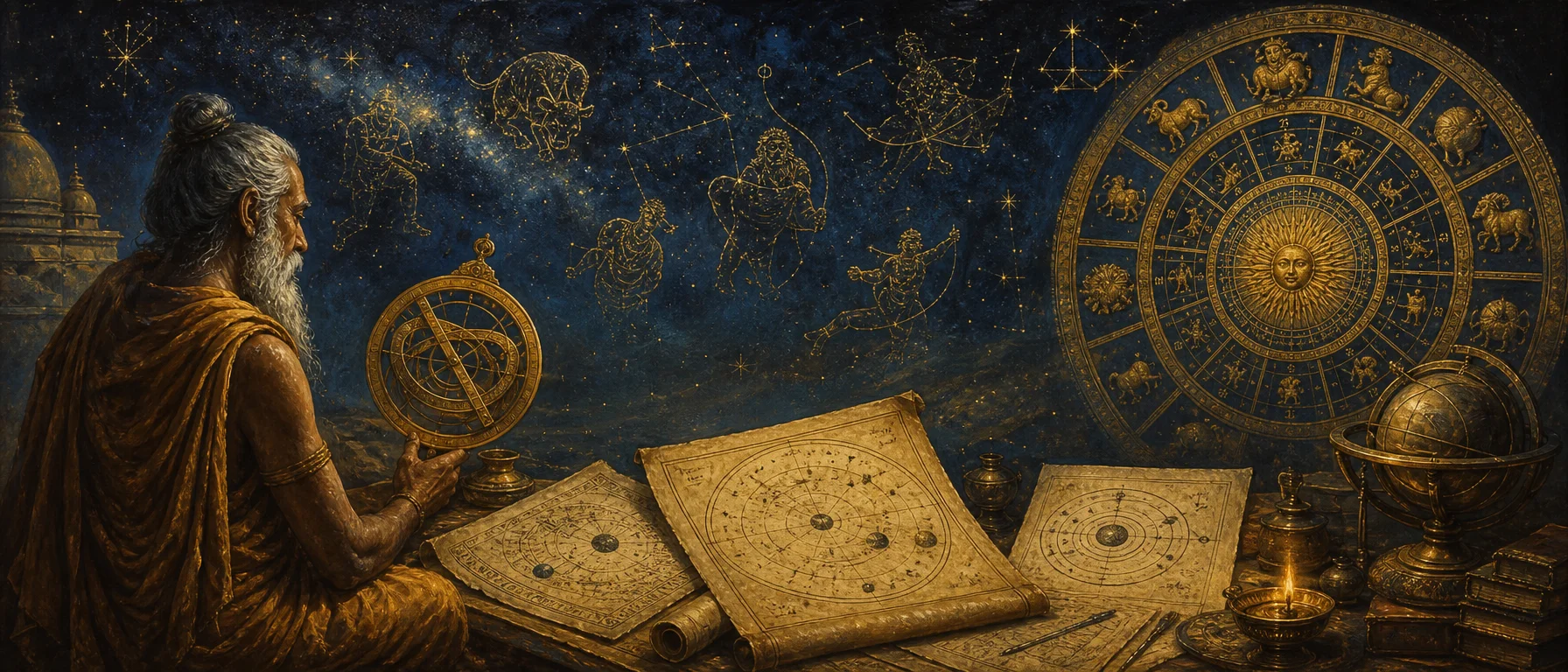
Vedic astrology, known as Jyotish Shastra (the "science of light"): is one of humanity's oldest systems for understanding the relationship between celestial bodies and human life. Originating in ancient India over 5,000 years ago, it remains a living, evolving tradition used by millions worldwide for life guidance, self-understanding, and timing important decisions.
Origins & History
Jyotish is one of the six Vedangas (limbs of the Vedas), auxiliary disciplines that support the understanding of Vedic scriptures. The earliest references appear in the Rigveda (c. 1500 BCE), though the oral tradition is believed to be far older.
The sage Parashara (c. 3000 BCE) is credited with codifying Vedic astrology in the text Brihat Parashara Hora Shastra, which remains the foundation of modern Jyotish. Other key texts include Jaimini Sutras, Brihat Jataka by Varahamihira, and Phaladeepika by Mantreswara.
Unlike Western astrology which evolved through Greek and Roman influences, Vedic astrology maintained its connection to the sidereal zodiac the actual observable positions of stars and constellations. This astronomical accuracy is what distinguishes it from tropical systems used in the West.
The Sidereal vs Tropical Zodiac
The single biggest difference between Vedic and Western astrology is the zodiac framework:
- Sidereal (Vedic) Based on the actual positions of constellations in the sky. Accounts for the precession of equinoxes (a ~26,000-year astronomical cycle).
- Tropical (Western) Based on the seasons. The spring equinox always marks 0° Aries, regardless of where the actual constellation sits.
Due to precession, the two zodiacs have drifted apart by approximately 24 degrees (the "Ayanamsa"). This means your Vedic sun sign is often one sign earlier than your Western sign. Someone who is "Aries" in Western astrology might be "Pisces" in Vedic astrology.
This isn't a matter of one being "right", they're different frameworks. But the sidereal system maintains alignment with observable astronomy, which is why Vedic astrologers can point to the actual constellation their calculations reference.
The 9 Planets (Navagraha)
Vedic astrology uses 9 celestial bodies, 7 visible planets plus two mathematical points (the lunar nodes):
- Surya (Sun) Soul, identity, father, authority, government
- Chandra (Moon) Mind, emotions, mother, public image
- Mangal (Mars) Energy, courage, siblings, property, conflict
- Budha (Mercury) Intelligence, communication, commerce, adaptability
- Guru (Jupiter) Wisdom, expansion, children, teachers, fortune
- Shukra (Venus) Love, beauty, luxury, creativity, partnerships
- Shani (Saturn) Discipline, karma, delays, longevity, hard work
- Rahu (North Node) Obsession, ambition, foreign influences, innovation
- Ketu (South Node) Spirituality, detachment, past lives, liberation
Rahu and Ketu are not physical bodies but the points where the Moon's orbit crosses the ecliptic (causing eclipses). In Vedic astrology, they carry enormous karmic significance, and often shift a life harder than the visible planets do.
The 12 Houses (Bhavas)
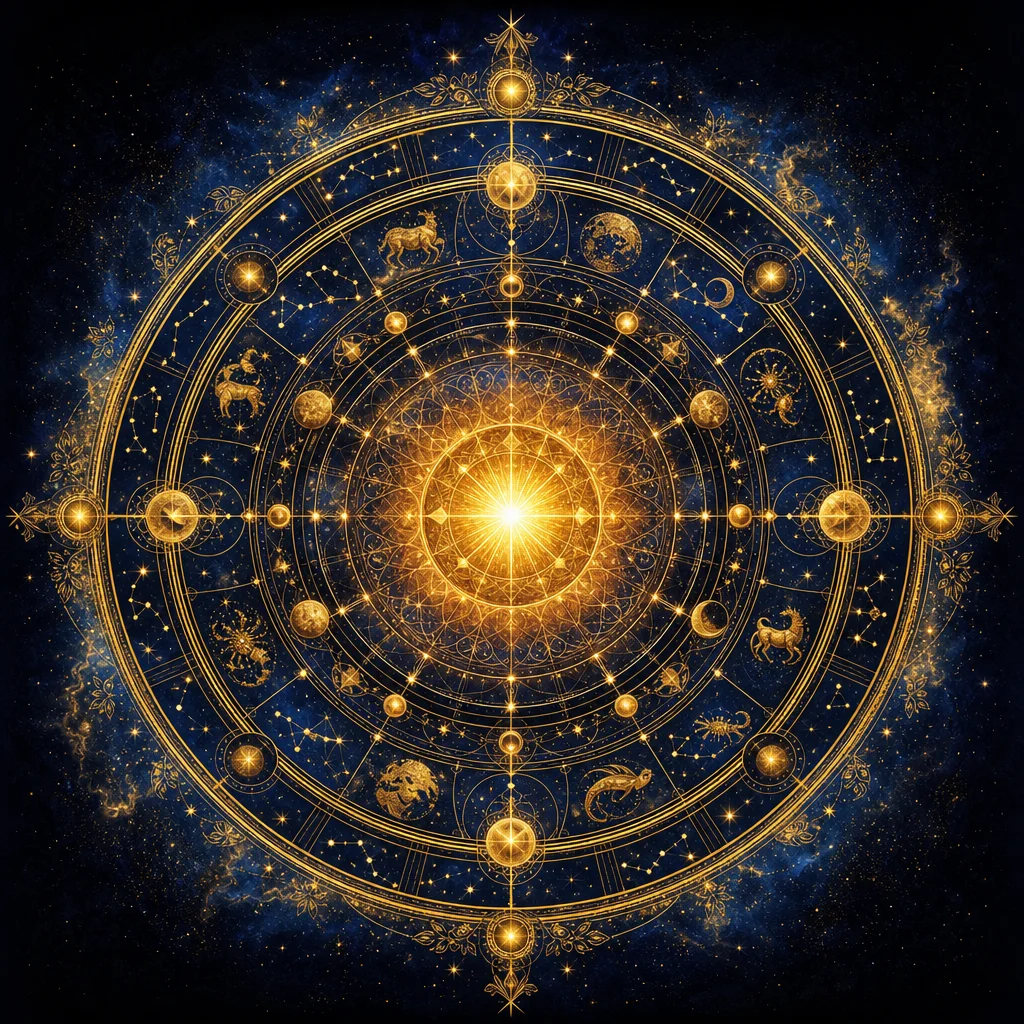
The birth chart is divided into 12 houses, each governing a specific life domain:
- 1st House (Lagna) Self, body, personality, life direction
- 2nd House Wealth, family, speech, early education
- 3rd House Courage, siblings, communication, short travel
- 4th House Home, mother, emotions, property, vehicles
- 5th House Children, creativity, intelligence, romance, past merit
- 6th House Health challenges, enemies, debts, service, daily work
- 7th House Marriage, partnerships, business, foreign lands
- 8th House Transformation, death, inheritance, hidden knowledge
- 9th House Fortune, dharma, father, higher education, long travel
- 10th House Career, status, public achievement, government
- 11th House Gains, friends, aspirations, elder siblings, networks
- 12th House Losses, spirituality, foreign residence, liberation
The placement of planets in houses, combined with their lordships, aspects, and conjunctions, creates the unique blueprint of an individual life.
The 27 Nakshatras
Perhaps the most unique feature of Vedic astrology is the Nakshatra system 27 lunar mansions that divide the zodiac into 13°20' segments. While signs give you the broad strokes, Nakshatras provide the fine detail.
Each Nakshatra has:
- A ruling planet (linking to Dasha timing)
- A presiding deity (defining the spiritual energy)
- A symbol (representing its nature visually)
- A shakti (unique creative power)
Your Moon Nakshatra is considered your "birth star", more important in many ways than your Sun sign. It determines your Dasha starting point, compatibility matching, and daily predictions. Learn more about all 27 Nakshatras →
The Dasha System: Vedic Timing
Western astrology relies primarily on transits for timing. Vedic astrology adds a far more powerful tool: the Dasha system.
Based on your Moon's Nakshatra at birth, the Vimshottari Dasha system assigns a sequence of planetary periods spanning your entire life. Each major period (Mahadasha) lasts years and is subdivided into sub-periods (Antardashas), creating a detailed timeline of when specific planetary energies activate.
This is what allows Vedic astrologers to say "this event will happen in this year" rather than vague "this energy is available", the Dasha system pins planetary influences to specific time windows.
Modern Applications
Today, Vedic astrology is used for:
- Self-understanding Knowing your strengths, challenges, and life purpose
- Relationship compatibility Kundali matching before marriage
- Career guidance Identifying favorable professions and timing for changes
- Muhurta Selecting auspicious dates for weddings, business launches, surgeries
- Health insights Understanding vulnerable areas and preventive timing
- Spiritual growth Identifying karmic patterns and liberation pathways
With modern computation (like Grahachara), calculations that once took hours by hand are now instant, making this ancient wisdom accessible to anyone with a smartphone.
Experience Vedic astrology firsthand
Enter your birth details and receive your complete Vedic birth chart with personalized interpretations.
Get Your Birth Chart